Articles
February 2026

Private Credit in Focus: What the Data Is Telling Us Now

Private credit continues to evolve in scale, structure, and complexity. As the market expands, the challenge is no longer access to opportunities, but visibility into risk, valuation, and inflection points across portfolios. By combining BDC filings, pre-trade observable data, and integrated public and private credit datasets, the SOLVE Workstation | BDC Data platform provides a clearer, more continuous view into how private credit is behaving beneath the surface. 

Taken together, recent research and analysis highlight both the durability of the asset class and the growing importance of data-driven decision-making.


Private Credit’s Growth Is Structural, Not Cyclical

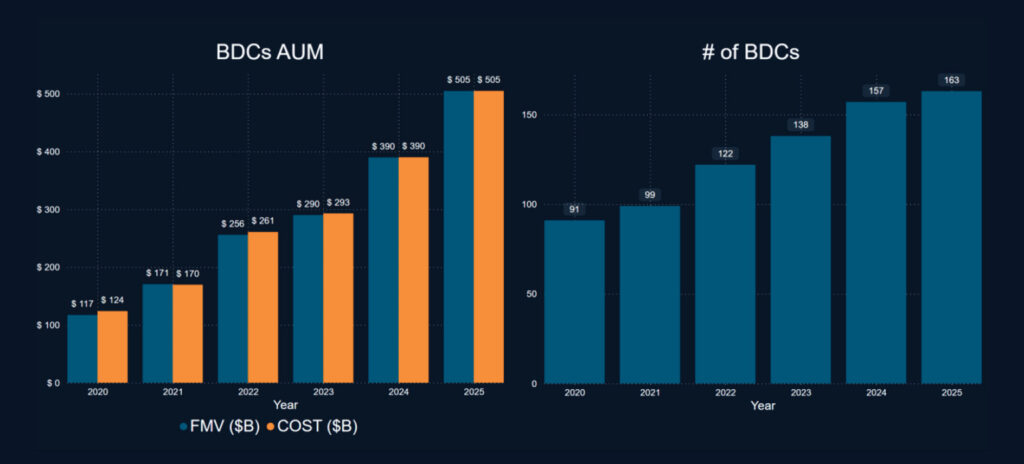
Private credit’s expansion is being driven by sustained capital inflows, broader geographic adoption, and deeper participation across CLOs, secondaries, and hybrid public-private strategies. This growth is not isolated to one segment of the market. It reflects a structural shift in how capital is deployed and how credit risk is intermediated globally. 

SOLVE’s data shows that as AUM increases, portfolio construction is becoming more nuanced. Managers are balancing yield, liquidity, and flexibility while navigating an environment where public and private markets increasingly intersect. Understanding these dynamics requires more than high-level trends. It requires granular visibility across instruments, issuers, and capital structures.

Source: Proprietary SOLVE Workstation | BDC Data

As the Market Grows, Dispersion Becomes More Important Than Direction

Growth alone does not tell the full story. A closer look at BDC non-accrual activity reveals a market that is not broadly deteriorating, but increasingly differentiated. Recent filings show modest increases in newly reported non-accruals, with exposure concentrated in specific sectors rather than spread evenly across portfolios. 

In 3Q 2025, 56 BDCs reported at least one new non-accrual, up from 42 in 2Q 2025, with newly reported non-accruals totaling $1.6 billion versus $1.2 billion the prior quarter. These new non-accruals now represent 26.3% of the $6.1 billion total, signaling modest quarter-over-quarter deterioration in credit performance.

  • Retail, consumer-facing industries, and select technology segments account for a meaningful share of new non-accrual activity, while healthcare and services continue to dominate overall non-accrual exposure.
  • This dispersion underscores a critical point. Risk in private credit is becoming more idiosyncratic, and sector-level monitoring is no longer sufficient on its own.

Valuations and PIK Usage Offer Early Clues, If You Know Where to Look

Portfolio marks remain generally stable, but the increased use of PIK structures introduces additional complexity into credit analysis. In some cases, PIK reflects thoughtful balance sheet management. In others, it can delay recognition of underlying stress. 

By integrating valuation data, capital structure detail, and historical issuer behavior, SOLVE allows users to assess whether PIK usage aligns with broader credit fundamentals or diverges from market reality. The goal is not to flag risk after NAV moves, but to understand how valuation and cash flow dynamics are evolving before outcomes are finalized. 

This level of transparency is increasingly critical as portfolios scale and traditional lagging indicators become less effective.

Seeing Stress Before It’s Widely Recognized

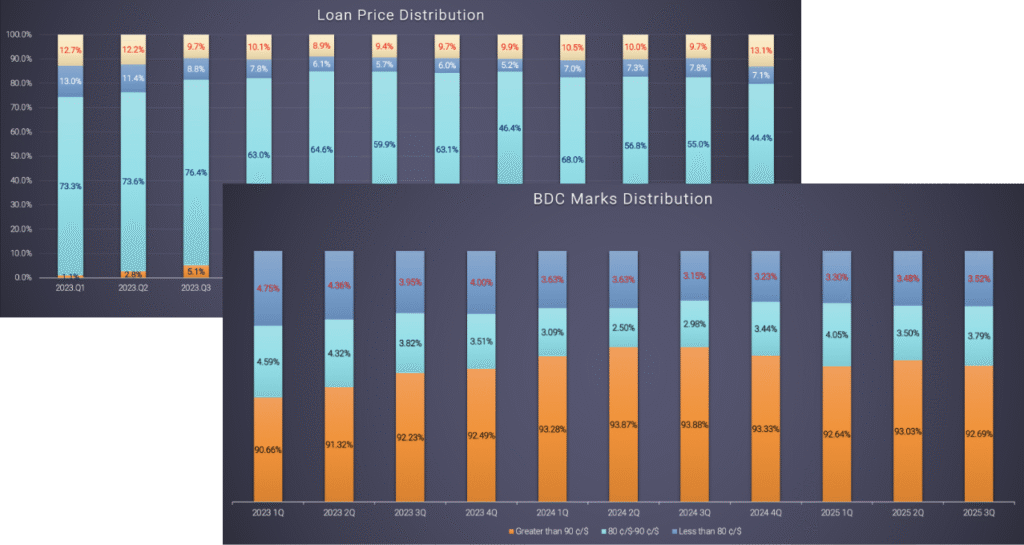
The earliest signs of credit stress often emerge in pricing behavior and liquidity dynamics, not in headlines or ratings actions. By combining pre-trade observable data with public and private credit datasets, SOLVE enables users to identify shifts in credit profiles as they happen. 

Indicators such as persistent pricing below key thresholds, rising non-accrual activity, and changes in PIK usage can be tracked across markets and capital structures. This allows portfolio managers, analysts, and restructuring teams to act with foresight rather than hindsight. 

The result is a more proactive approach to credit risk, grounded in data that reflects real market behavior.

Turning Insight Into Action

Private credit remains a resilient and strategically important asset class. But as it continues to grow, the margin for error narrows. Success increasingly depends on the ability to see across markets, identify dispersion early, and understand how risk is evolving in real time. 

The SOLVE Workstation and BDC Data Platform are designed to support that shift. By bringing together filings, pre-trade data, and predictive analytics, they provide the transparency needed to navigate private credit with confidence.

Subscribe to SOLVE's Market Summaries
SHARE

Related Resources

About SOLVE

SOLVE is the leading market data platform provider for fixed-income securities, trusted by sophisticated buy-side and sell-side firms worldwide. Founded in 2011, SOLVE leverages its AI-driven technology and deep industry expertise to offer unparalleled transparency into markets, reduce risk, and save hundreds of hours across front-office workflows. With the largest real-time datasets for Securitized Products, Municipal Bonds, Corporate Bonds, Syndicated Bank Loans, Convertible Bonds, CDS, and Private Credit, SOLVE empowers clients to transform the way they bring new securities to market, trade on secondary markets, and value highly illiquid securities. Headquartered in Connecticut, with offices across the globe, SOLVE is the definitive source for market pricing in fixed-income markets.