Articles
March 2026

From Signals to Action

Seeing Stress First: What the Data Is Telling Us Now

Credit stress rarely begins with a bankruptcy filing. It starts earlier, in pricing shifts, dispersion across ratings bands, sector weakness, and subtle changes in capital structure behavior. The challenge for market participants is not reacting to distress, but identifying it before it becomes consensus. 

In our recent webinar, Seeing Stress First: How SOLVE Is Transforming Restructuring Across Public and Private Credit, we walked through how integrated loan and private credit data can surface those signals early, and what the market is showing right now. 


Early Detection Is a Competitive Advantage

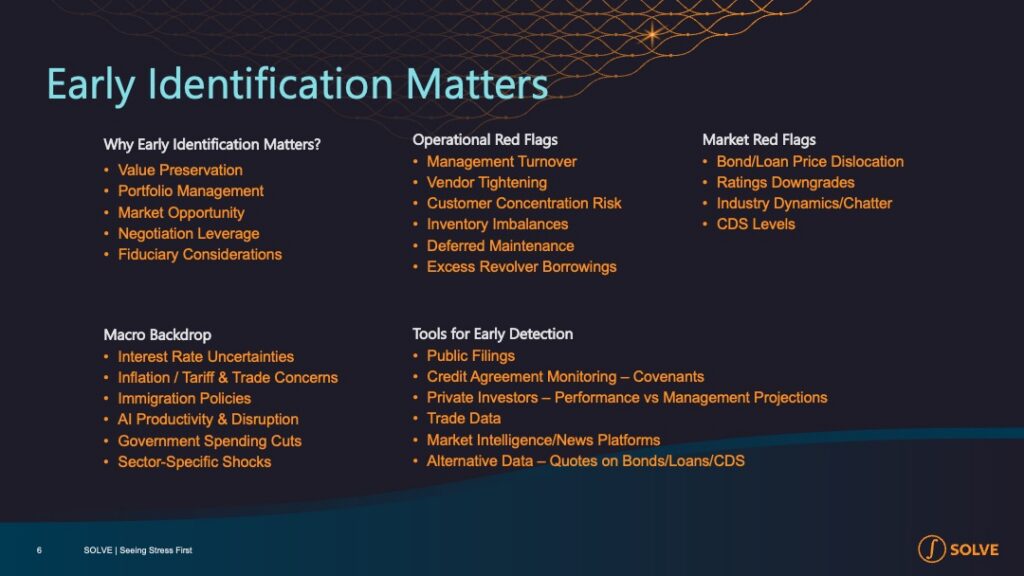
Early stress identification matters for more than risk mitigation. It affects:

Early Identification Matters
  • Value preservation 
  • Portfolio positioning 
  • Negotiation leverage 
  • Fiduciary timing 
  • Strategic optionality

Distress typically unfolds in stages. Operational signals appear first, management turnover, increased revolver usage, vendor tightening, inventory imbalances. Market signals follow, like price dislocations, ratings downgrades, widening CDS levels, and sector contagion. 

By the time financial statements confirm the problem, the market has often already repriced the risk. 

That’s why combining filings data, trade data, and real-time observable pricing creates a materially stronger early-warning framework.

Loan Yields Over Time: The Headline Isn’t the Full Story

Loan yields have generally declined over the past two years, largely reflecting changes in the rate environment. As benchmark rates have eased, overall yield-to-maturity levels have followed.

At a high level, that looks constructive. 

But headline yields don’t tell the whole story. When you strip out base rate effects and focus on spread and discount margin behavior, you begin to see divergence, particularly in lower ratings bands. That dispersion is where early stress often shows up. 

It’s not the aggregate level that matters most. It’s how risk is being repriced within cohorts.


Loan Price Distribution: Watch the 90 and 80 Thresholds

One of the clearest stress indicators is price distribution across the loan universe. 

Two thresholds matter: 

  • Below 90: often signals emerging weakness 
  • Below 80: typically reflects material stress or restructuring risk 

Over the past several quarters, loans priced below 90 have begun to tick higher again after prior improvement. More notably, the percentage of loans trading below 80 has moved above post-COVID lows and is rising.

This doesn’t signal systemic distress, but it does suggest selective deterioration. 

When lower-rated cohorts begin to widen while higher-quality loans remain stable, that’s often the early phase of credit cycle differentiation.

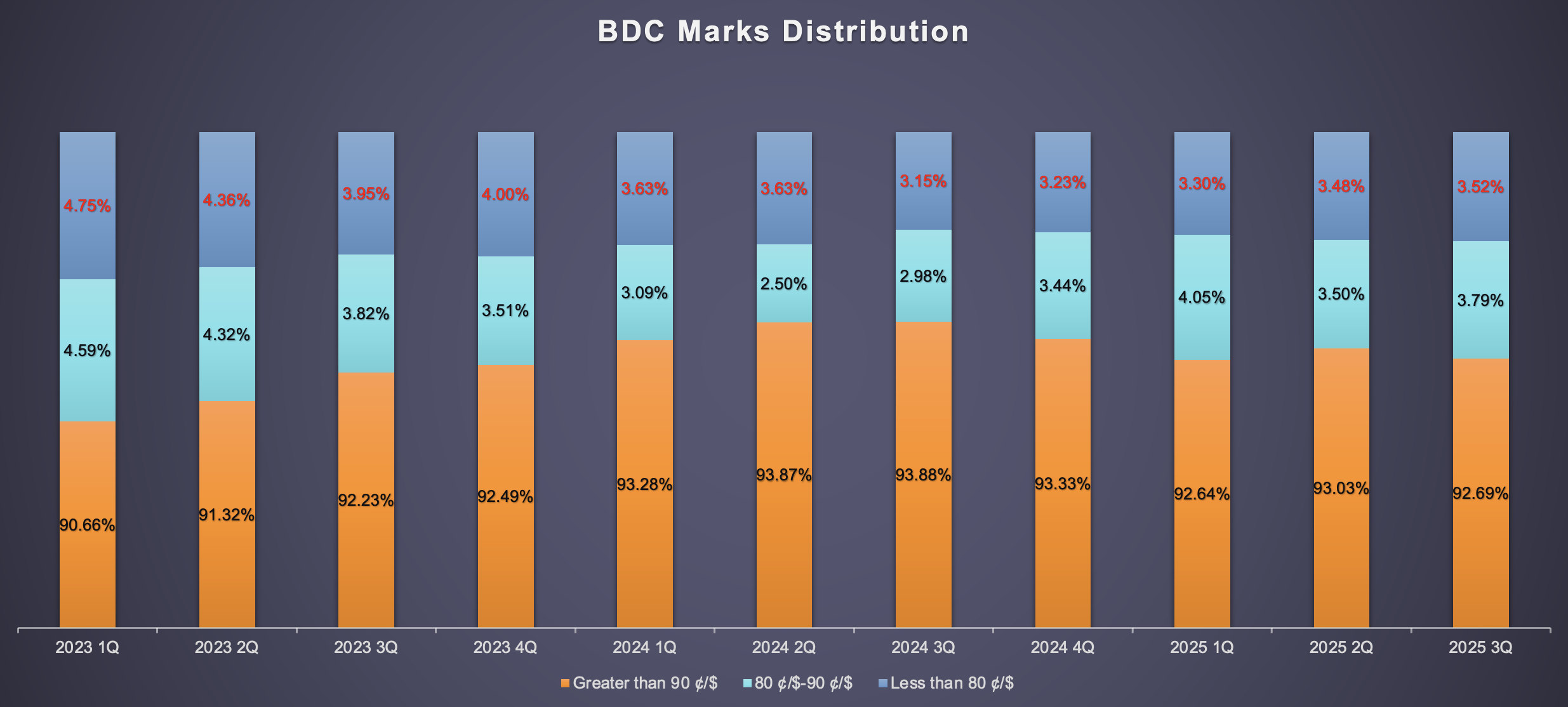
BDC Mark Distribution: StableBut Monitor Closely

Private credit marks, as reported by BDCs, remain relatively healthy. 

The vast majority of investments continue to be marked above 90, with a small percentage below 80. On the surface, valuations appear stable. 

However, two things warrant attention: 

  1. Quarter-over-quarter changes in the 80–90 bucket 
  2. Movement in new non-accruals and PIK usage (covered separately in the webinar) 

Even modest increases in lower mark categories can indicate building pressure beneath the surface.

BDC Marks Distribution

BDC filings remain one of the few transparent windows into private credit performance. When combined with pre-trade observable pricing, they provide a clearer picture of where market sentiment and reported valuations diverge.


The Bigger Picture

We are entering a period of heavier refinancing activity and rising maturity walls. With trillions in corporate debt coming due over the next several years, not every borrower will refinance seamlessly. 

In this environment: 

  • Watch spread dispersion, not just aggregate yields 
  • Monitor price distribution below 90 and below 80 
  • Compare reported marks with observable market levels 
  • Track sector-specific deterioration

Stress doesn’t arrive all at once. It builds in pockets. Those who see it first preserve capital, improve outcomes, and identify opportunity before the broader market reacts.


Want to dig deeper?

Subscribe to SOLVE's Market Summaries
SHARE

Related Resources

About SOLVE

SOLVE is the leading market data platform provider for fixed-income securities, trusted by sophisticated buy-side and sell-side firms worldwide. Founded in 2011, SOLVE leverages its AI-driven technology and deep industry expertise to offer unparalleled transparency into markets, reduce risk, and save hundreds of hours across front-office workflows. With the largest real-time datasets for Securitized Products, Municipal Bonds, Corporate Bonds, Syndicated Bank Loans, Convertible Bonds, CDS, and Private Credit, SOLVE empowers clients to transform the way they bring new securities to market, trade on secondary markets, and value highly illiquid securities. Headquartered in Connecticut, with offices across the globe, SOLVE is the definitive source for market pricing in fixed-income markets.